
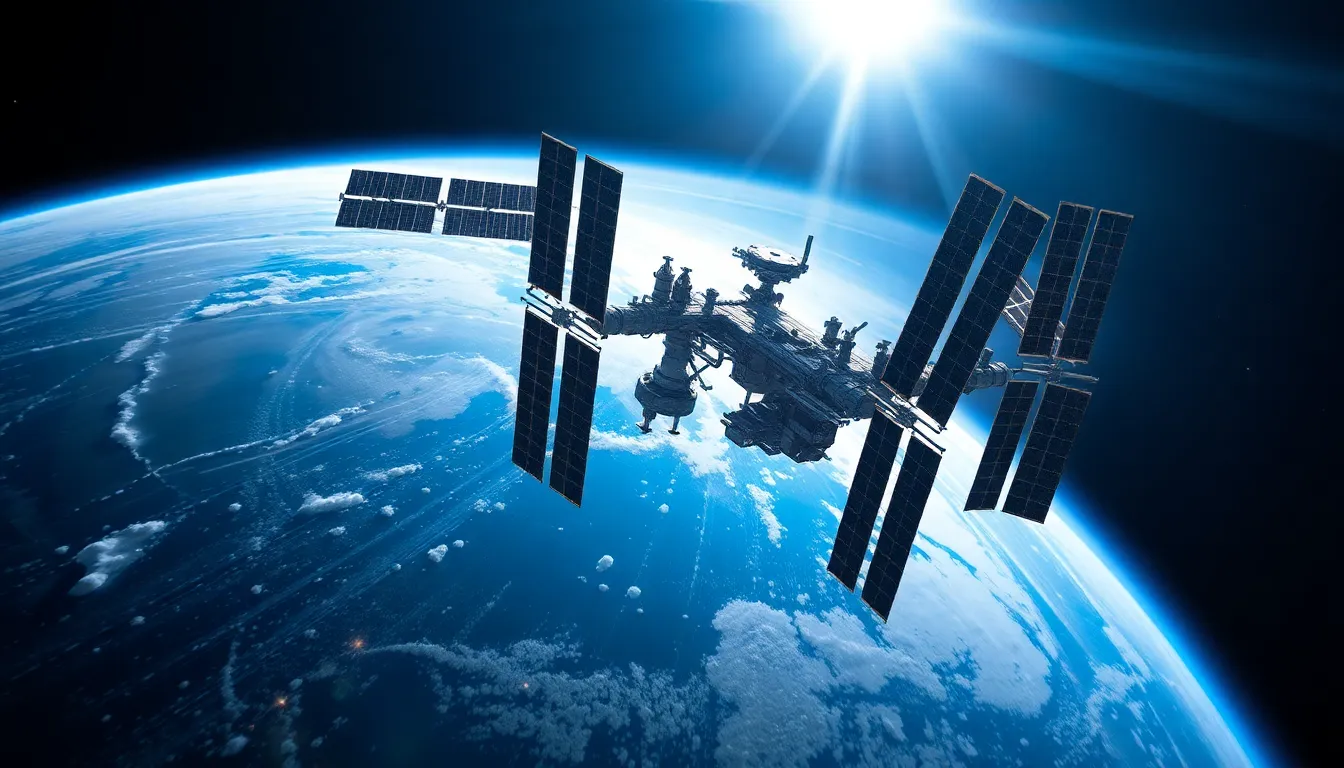
Ever wondered where the International Space Station is right now? It’s not just floating around aimlessly like a lost sock in a dryer. This marvel of engineering zips around the Earth at a staggering speed of 17,500 miles per hour, making it a cosmic superstar in the sky.
Table of Contents
ToggleOverview of the International Space Station
The International Space Station (ISS) serves as a unique laboratory in low Earth orbit. This massive structure orbits the Earth approximately every 90 minutes. Composed of multiple interconnected modules, the ISS supports a variety of research and technology demonstrations. Astronauts aboard conduct experiments in fields such as biology, physics, and astronomy.
In terms of size, the ISS measures about the length of a football field. Sixteen countries collaborate in its construction and operation, highlighting international cooperation in space exploration. Funding from NASA, along with contributions from agencies like ESA, Roscosmos, JAXA, and CSA, supports ongoing efforts. Equally important, the ISS remains a demonstration of sustained human presence in space.
Power for the station comes from large solar arrays. These arrays track the sun and generate electricity, ensuring that systems remain operational. Environmental controls, advanced life support systems, and research facilities facilitate long-duration missions. For instance, astronauts often stay on the ISS for six months at a time.
Communication with Earth occurs through a series of ground stations. These stations relay data, enabling real-time monitoring of experiments and station systems. Researchers on the ground anticipate valuable findings that contribute to scientific advancements. Optimal docking facilities allow for resupply missions, ensuring that astronauts have the necessary resources.
At any given moment, the ISS orbits approximately 250 miles above the Earth’s surface. The station serves not only scientific purposes but also inspires future generations of explorers.
Current Location Tracking
Tracking the International Space Station’s current location relies on a variety of tools and resources. These resources provide accurate, real-time data on the ISS’s position above the Earth.
Tracking Tools and Resources
Satellite tracking software enables observers to follow the ISS’s trajectory. Tools like Heavens-Above and ISS Tracker offer details about its elevation, speed, and direction. NASA’s website provides live updates, ensuring users stay informed. Various mobile applications also allow users to receive notifications about the ISS’s visibility in their area. This combination of resources enhances the ability to monitor the ISS efficiently.
Live Tracking Websites
Live tracking websites display the International Space Station’s path across the sky. Websites such as N2YO, Space Station Tracker, and CelesTrak feature interactive maps showcasing its current location. These platforms highlight the ISS’s altitude, speed, and upcoming overpasses, allowing enthusiasts to pinpoint the best times for observation. Users can also find details about how long the ISS will be visible from specific locations. Engaging with these websites makes tracking the ISS straightforward and exciting.
Importance of Knowing Its Location
Tracking the ISS’s location holds significant value for multiple reasons.
Scientific Research and Experiments
Real-time tracking of the ISS facilitates the execution of various scientific experiments. Scientists design experiments based on its position relative to Earth, ensuring optimal conditions for observation. Research involving fluid dynamics or biological growth may yield different results depending on the ISS’s angle to the Sun. Moreover, precise location data help coordinate collaboration between international teams maximizing research outcomes. Understanding its trajectory allows researchers to gather data to advance knowledge across critical fields like biology and physics.
Educational Outreach
Knowledge of the ISS’s location serves as a powerful educational tool. Schools leverage live tracking to engage students in discussions about space, science, and technology. Real-time updates spark interest in STEM fields and inspire future generations of scientists and explorers. Various mobile apps and websites provide user-friendly interfaces, enhancing accessibility for educators and students alike. With the ISS visible from many locations, teachers can organize observation events, connecting theoretical learning with real-world experiences. This practical engagement strengthens students’ understanding of space exploration and its impact on society.
Future of the International Space Station
Funding plans outline the extension of the ISS’s operational lifespan until at least 2028. NASA, along with international partners, actively works on transitioning research from the ISS to commercial space stations. Collaborations with private companies aim to foster a new era of space research and production.
Upcoming missions involve further scientific inquiries in microgravity, contributing to advancements in areas such as pharmaceuticals and materials science. Each experiment conducted aboard the ISS paves the way for significant breakthroughs that improve life on Earth.
Transitioning responsibilities to commercial entities will diversify the research landscape. Researchers anticipate that commercial stations can facilitate lower-cost, more flexible access to low Earth orbit. As funding shifts, partnerships with private sectors create opportunities for innovation and economic growth in space exploration.
Potential successors to the ISS are already in conceptual development. Emerging designs for space stations incorporate advanced technologies, enhancing sustainability and efficiency. These platforms promise to support long-term human habitation in space, a vital step for future deep space missions.
Moreover, educational initiatives tied to the ISS’s future focus on inspiring the next generation of scientists and engineers. Programs aimed at students utilize data from ISS missions to enrich STEM education. Engaging students with real-time information stimulates curiosity about space and scientific exploration.
Retirement of the ISS raises questions about its legacy. Optimistically, it will serve as a foundation for all future endeavors in space, fostering international cooperation and collaborative achievements. As the landscape of space research evolves, ongoing efforts guarantee that humanity’s presence in low Earth orbit continues to thrive.
The International Space Station remains a remarkable testament to human ingenuity and international collaboration. Its real-time tracking capabilities allow enthusiasts and scientists alike to engage with its journey and contributions to research. As the ISS continues to orbit Earth at incredible speeds, it plays a critical role in advancing our understanding of science and technology.
Looking ahead, the transition to commercial space stations promises to expand research opportunities while inspiring future generations. The legacy of the ISS will undoubtedly influence the next chapter of space exploration, ensuring that humanity’s quest for knowledge and discovery continues to flourish beyond the boundaries of our planet.